
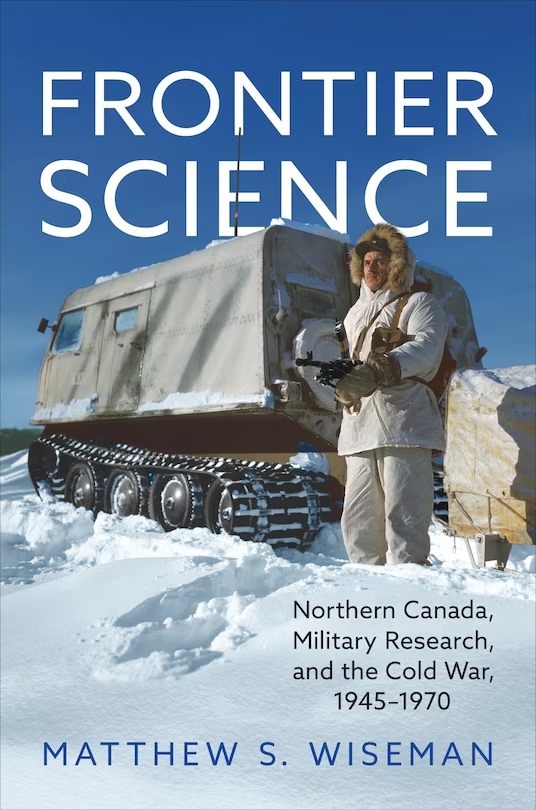
 In the early years of the Cold War, hundreds of soldiers, sailors, and aviators from Canada, Britain, and the United States trained in the outdoors near Fort Churchill, fighting the natural elements and perfecting Arctic techniques and tactics. Scientists and engineers also played an important role, using brainpower to study and improve military kit, weapons, and equipment for everyday use in the Arctic. In this talk, Matthew S. Wiseman will discuss his recent book, Frontier Science: Northern Canada, Military Research, and the Cold War, 1945-1970, highlighting the rise and fall of Fort Churchill to investigate the most challenging issue of Canadian defence in the postwar Arctic: the human body.
This is a hybrid event. Attend in person at the Laurier Centre for the Study of Canada or CLICK HERE to register for the Zoom broadcast.
Matthew S. Wiseman is an Assistant Professor at the University of Waterloo. He has published extensively on international history and the role of military science in the context of Canadian defence and national security during the Cold War. His books include a monograph on the history of science in northern Canada and the Canadian Arctic between 1945 and 1970, an edited collection of government policy papers written by the late nuclear physicist and military strategist George Lindsey, and a co-edited volume on Canada’s political economy and the military-industrial complex.
Laurier Centre for the Study of Canada
232 King Street North
Room K108
Waterloo, ON
lcsc@wlu.ca